
Focus on Function First
Article #1 in the Floored Series
As some of you may know I am currently in the process of designing our next family home. It’s been a long and winding road so far and we haven’t even started the build yet. I can’t even tell you how many iterations of our plan that we’ve had (my unnatural obsession for floor plans likely has something to do with this!) However, the numerous versions of the plans has brought with it numerous learnings. Given this, I am starting a series of floor planning posts that outline those floor planning learnings. The first in this Floored series is called “Focus on Function First.”
When you design a new home or renovate an existing space, the floor plan is the blueprint for how you will live. It’s more than just drawing walls; it's about translating your daily life and needs into a three-dimensional space. The first and most critical area to focus on is function.
Define your needs
Before you even begin to talk to your design person (i.e. draftsperson, architect, design/build firm etc), develop a detailed inventory of what you need in your space, but more importantly how you plan to use each of those spaces. Function drives form.
Who is going to use the space? Firstly, who is going to use the home AND each of the spaces within the home? Is the home for a single person? A family? How many people are in the family? How old? Questions like this begin to form a framework for certain elements that might be needed. For instance, for our family of four we knew we wanted each of our girls to have their own bedroom and ensuite.
What is the main purpose? For each of the spaces, go through and list who will use the space and what they will do in each of the spaces? We often operate with implicit assumptions about what spaces are needed, without checking those assumptions. Do you really need a big main floor office? For our family we said no. It was more important to have a smaller, quieter pocket office on the main floor and another landing space for working in another location of the house than one big office that only one person could work in.
How is the space going to be used? It may seem obvious at first. Kitchen=cooking (duh!) However, some people don’t even cook, so having a big kitchen for that person doesn’t make sense. For us, the kitchen is the first place we go in the morning. It is a whirlwind of activity - one person is making coffee, one is making breakfast and smoothies, then there are lunches being made, all with the news on in the background. Given this, it was important that we designed a kitchen that had separate zones for coffee, cooking and lounging so we aren’t running all over each other.
What ancillary activities occur here? For a kitchen, this might include dining, paying bills, or homework. For a bedroom, it might include reading, dressing, drinking coffee or meditation. For our kitchen we knew we needed a loungey spot to have coffee in the morning and watch the news. We also know that when guests come over everyone sits in the kitchen so having additional space, other than barstools at an island, was needed. We also knew we needed a “home management” space. We have phones, iPads, iWatches and too many cords and charging blocks. We needed a central station to house all of those, not to mention our family calendar, mail, and other misc kids items. Given this we’ve created a home management station directly behind the kitchen for his purpose.
What items need to be stored? As mentioned above, think about all those items you may have laying around the house, but perhaps don’t have a place for. Additionally, what items do you store in your home, but have to work hard to access? Our life/weekends seems to revolve around attending my kids’ friend’s birthday parties. We are running up and down our basement stairs every time we need to grab a gift bag or wrapping paper. The home management space we incorporated in our new plan will also have storage to accommodate these types of items.
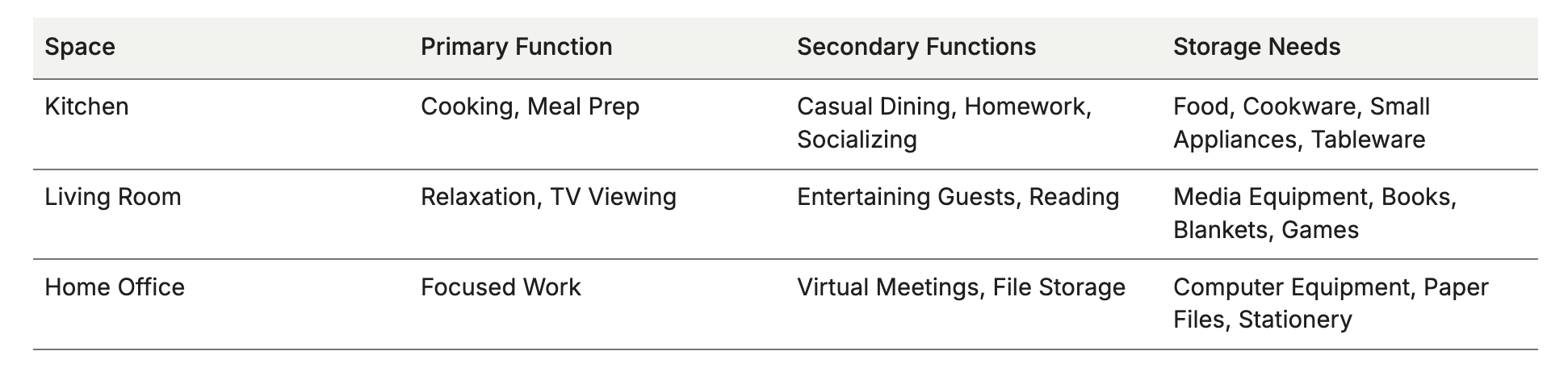
Activity Mapping Example
2: Optimal Room Placement (Zoning)
The location of a room should be dictated by its function and relationship to other activities in the house. This is often referred to as "zoning." Effective zoning separates different areas of the home to minimize noise, maximize privacy, and improve convenience. I read the other day that a good house plan should be one where the house reveals itself as one goes through it. For instance, the public/social zones that guests and family interact in are typically near the front entrance, whereas the more daily maintenance activities (cooking, laundry, mudroom, etc) are located in more disguised areas, sometimes toward the back of the house. Private zones, like bedrooms, should be placed away from noisy social and service zones.
As with any design, I think it is important to know “the rules” but also know when to break them. When we began talking about placement of rooms for our floor plan I knew that I wanted our living area to be located close to the front of the house, not because the rules says that the living room should, but because I currently live in a house where the living room is at the back of the house and I feel like I’m staring at my garage most of the day instead of the beautiful tree-lined streets. However, my friend who is also designing a home in the area prefers her living room at the back of the house. She said in her previous house her living space was at the front of her house and she felt like she was living in a fish bowl all the time with people walking by on the sidewalks.
Again, how does the space need to function for YOU? What privacy needs are important for you? What lighting needs are important for you? Do you like lots of natural light or a darker, moodier space? At what times in the day? Do you like your dining room open to your kitchen or separated? Do you like your kitchen open to your living room or separate? All of these will help you layout your plan so the rooms are in the right spot. Here is an example of what I laid out prior to meeting with our design team.
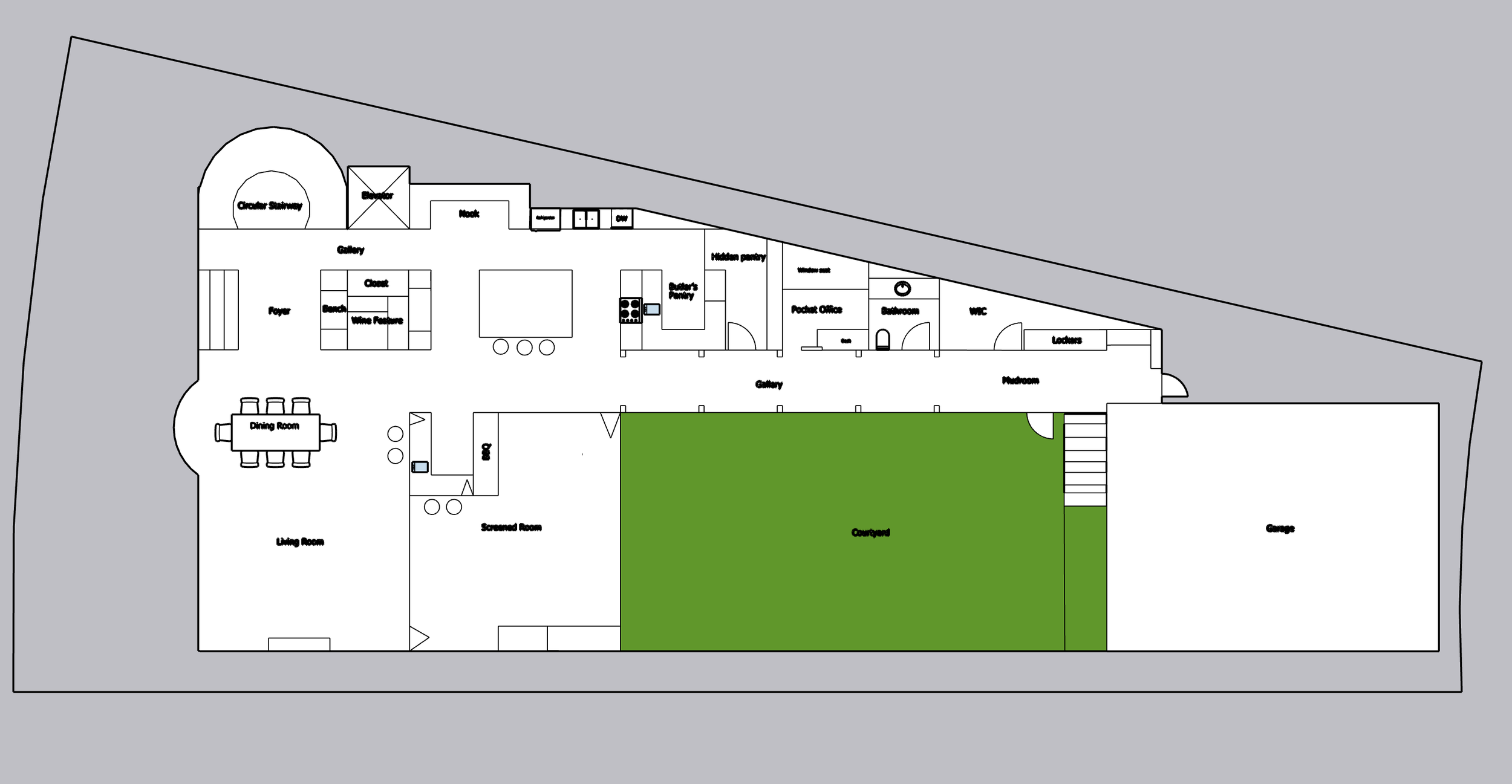
Conceptual Layout of Main Floor Rooms
A well-designed floor plan starts with well thought out, intentional spaces that function right for you, but naturally relate to one another. The next article in this Floored series (available next Friday!) will dig deeper into this concept of how rooms relate to one another - the concept of Flow.
